

 Español
 Русский
Jiaji Forging, a leading flange manufacturer based in Zhejiang, China, specializes in high-quality forged flanges for demanding refinery, petrochemical, and marine applications. With ISO 9001 and PED 2014/68/EU certifications, our products meet ASME, ASTM, EN, and API standards.
| Feature | Slip-On Flange | Weld Neck Flange |
|---|---|---|
| ASME B16.5 Rating | Class 150 to 2500 | Class 150 to 2500 |
| Typical Size Range | 1/2" to 24" | 1/2" to 24" |
| Pressure Capacity | Moderate (70-80% of WN) | Full rated pressure |
| Fatigue Resistance | Lower | High |
| Installation Cost | Lower | Higher |
| Typical Use | Low-pressure, non-critical | High-pressure, critical |
| Standards | ASME B16.5, ASTM A105/A182 | ASME B16.5, ASTM A105/A182, EN 1092-1 |
| Common Materials | Carbon steel, stainless steel | Carbon steel, alloy steel, duplex |
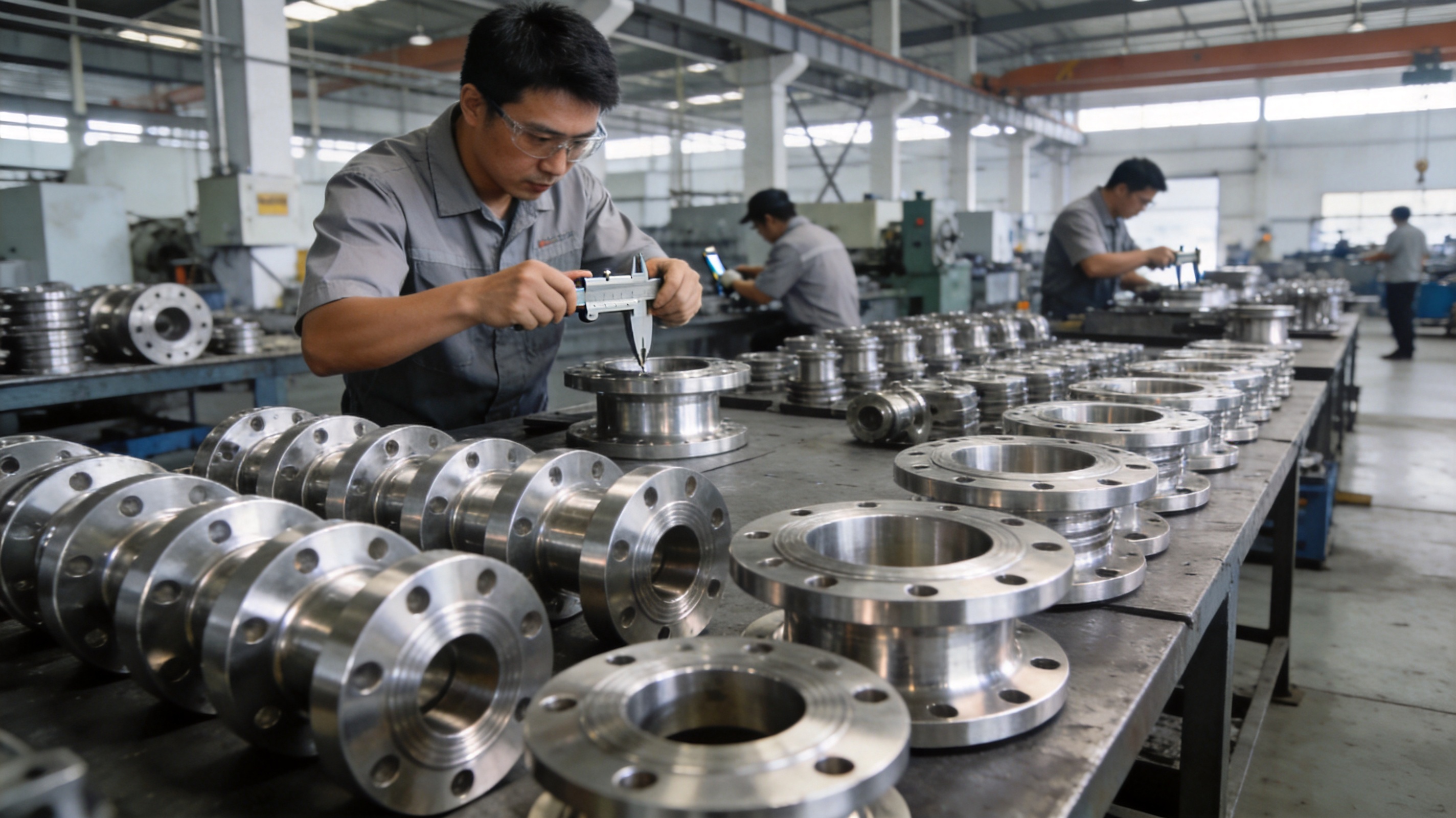
ASME B16.5 Slip-On vs Weld Neck Flanges: Market Overview
The global flanges market reached $5.44 billion in 2025 and is projected to grow to $5.82 billion by 2026, driven by refinery expansions in the Middle East, Caspian region, and Southeast Asia. As refineries upgrade aging infrastructure and adopt higher pressure/temperature processes, the choice between ASME B16.5 slip-on flanges and weld neck flanges becomes critical for safety, cost, and longevity. The EU's Carbon Border Adjustment Mechanism (CBAM), fully effective in 2026, is pushing procurement managers toward certified manufacturers with low-carbon forging processes, such as Jiaji Forging.
Technical Analysis: Slip-On vs Weld Neck Design and Performance
Slip-On Flange Design and Limitations
Slip-on flanges (SO) slide over the pipe and are welded both inside and outside. They are easier to align during installation, reducing labor costs. However, their stress distribution is less favorable—studies show slip-on flanges can handle only 70-80% of the rated pressure of equivalent weld neck flanges under cyclic loading. In critical refinery services (e.g., hydrocracking, fluid catalytic cracking), this can lead to premature failure. For low-pressure, non-critical lines (cooling water, steam, low-pressure process), slip-on flanges remain cost-effective, especially in sizes up to 24" and Class 150-600.
Weld Neck Flange Advantages for High-Pressure Systems
Weld neck flanges (WN) feature a tapered hub that transitions stress from the flange face to the pipe, offering superior fatigue resistance. They are the preferred choice for severe service conditions: high pressure (Class 900-2500), high temperature (>400°C), and cyclic or thermal shock loads. For EN 1092-1 Type 11 vs ASME B16.5 weld neck flanges, the ASME standard is dominant in North American and Middle Eastern refineries, while EN 1092-1 is common in European and Caspian projects. Both standards require strict adherence to dimensional and material specifications.
Key Specifications and Standards for Refinery Flanges
Refinery piping systems demand compliance with multiple standards. ASME B16.5 covers pressure-temperature ratings, dimensions, tolerances, materials, and testing for flanges up to 24". For larger diameters, ASME B16.47 Series A and B apply. Material selection is governed by ASTM standards:
- ASTM A105 – Carbon steel for general service
- ASTM A182 F304/F316 – Stainless steel for corrosive environments
- ASTM A182 F51/F53 – Duplex and super duplex for high chloride, sour service (see A182 F51 vs F53 comparison)
- ASTM A350 LF2 – Low-temperature carbon steel for cryogenic service (A350 LF2 vs A182 F304)
Quality assurance includes ISO 9001, PED 2014/68/EU (CE marking), and API 6A/6D for oil and gas. The forging process itself—open die, closed die, or rolled ring—affects grain flow, mechanical properties, and cost. Jiaji Forging uses advanced forging techniques to minimize defects and ensure consistency.
Selection Guide: How to Choose Between Slip-On and Weld Neck Flanges
When selecting flanges for refinery piping, consider the following checklist:
- Pressure and temperature rating: Use weld neck for Class 900 and above, or where temperature exceeds 400°C.
- Cyclic loading: Weld neck flanges offer higher fatigue life—essential for compressor stations, pump connections, and thermal cycles.
- Corrosion environment: For sour gas (NACE MR0175/ISO 15156), use low-alloy or duplex materials. See Duplex 2205 vs Super Duplex 2507.
- Cost constraints: Slip-on flanges are 10-20% cheaper in material and 30% less in installation labor, but consider lifecycle cost.
- Standards compliance: Ensure flanges meet ASME B16.5, EN 1092-1, or GOST 33259 for Caspian/CIS projects (Top GOST 33259 suppliers).
- Certification: Verify ISO 9001, PED, and material traceability. For offshore pipeline projects, API 6A/6D certification is mandatory.
- Custom requirements: High-end custom flanges represent 42% of top-tier export orders—custom forging can optimize weight, dimensions, and material for specific refinery units.
For high-pressure vessel applications, blind flanges are used to seal ends, but the same material and rating logic applies.
Frequently Asked Questions
Q: What is the main difference between slip-on and weld neck flanges?
A: The main difference is the hub design. Weld neck flanges have a tapered hub that provides a smooth stress transition, making them stronger under high pressure and cyclic loads. Slip-on flanges slide over the pipe and are welded on both sides, offering easier alignment but lower pressure capacity.
Q: Can slip-on flanges be used in high-pressure refinery services?
A: Slip-on flanges are not recommended for high-pressure (Class 900+) or severe cyclic services. They are suitable for low-pressure, non-critical lines such as cooling water, low-pressure steam, and utility systems.
Q: What materials are commonly used for refinery flanges?
A: Carbon steel (ASTM A105) for general service, stainless steel (A182 F304/F316) for corrosive environments, and duplex/super duplex (A182 F51/F53) for high-chloride or sour service. Alloy steels like A182 F11/F22 are used for high-temperature applications.
Q: How do I ensure flange quality for EU projects?
A: Look for PED 2014/68/EU (CE marking) certification, ISO 9001 quality management, and material traceability. Jiaji Forging provides full documentation and third-party inspection upon request.
Q: What is the cost difference between slip-on and weld neck flanges?
A: Slip-on flanges are typically 10-20% cheaper in material cost and 30% less in installation labor due to easier alignment. However, for critical applications, the higher initial cost of weld neck flanges is offset by longer service life and lower maintenance.
Q: Are there dimensional differences between ASME B16.5 and EN 1092-1 flanges?
A: Yes, ASME B16.5 uses inch-based dimensions (e.g., 1/2" to 24") while EN 1092-1 uses metric (DN 10 to DN 600). Bolt patterns, face dimensions, and pressure ratings differ. For international projects, confirm which standard applies.