

 Español
 Русский
Jiaji Forging is a premier Chinese manufacturer and exporter of forged flanges, serving the global oil & gas, petrochemical, and offshore industries since 2005. With over 18 years of expertise, we specialize in high-performance duplex and super duplex flanges, including Duplex 2205 vs Super Duplex 2507 flanges, produced under strict quality controls. Our facility in Cangzhou, Hebei, features 12 forging presses and advanced CNC machining centers, enabling us to deliver flanges from 1/2″ to 60″ in pressure classes 150–2500. We hold certifications such as PED 2014/68/EU, ISO 9001, and API 6A, ensuring compliance with international standards like ASME B16.5, EN 1092-1, and GOST 33259. Our team of 50+ engineers provides tailored solutions for offshore projects, from the North Sea to the Caspian Sea. Visit our About Us page to learn more about our commitment to quality and innovation.
TL;DR: For offshore projects, Duplex 2205 flanges offer a cost-effective balance of strength and corrosion resistance for moderate environments (e.g., seawater piping), while Super Duplex 2507 flanges deliver superior strength and pitting resistance for extreme conditions (e.g., deepwater, sour gas). Key differentiators: Duplex 2205 has PREN ≥35, yield strength ~450 MPa; Super Duplex 2507 has PREN ≥40, yield strength ~550 MPa. Choose 2205 for budget-sensitive, low-chloride applications; choose 2507 for high-pressure, high-chloride, or H₂S environments. Always verify with project specifications and complete guide to forged flanges.
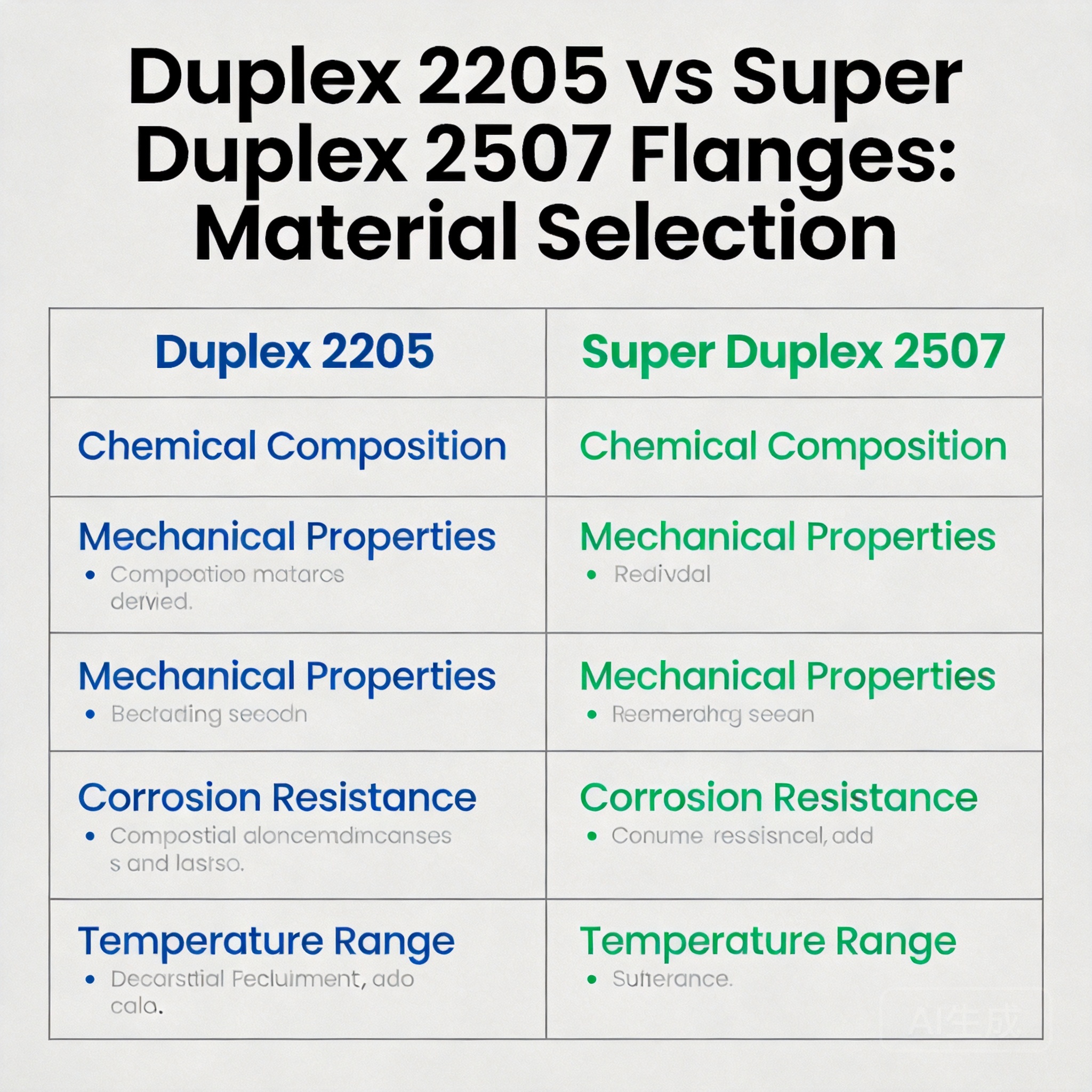
| Property | Duplex 2205 (UNS S31803/S32205) | Super Duplex 2507 (UNS S32750) |
|---|---|---|
| PREN (Pitting Resistance Equivalent Number) | ≥35 | ≥40 |
| Yield Strength (MPa) | 450 | 550 |
| Tensile Strength (MPa) | 620 | 800 |
| Elongation (%) | 25 | 15 |
| Max Operating Temperature (°C) | 300 | 300 |
| SCC Resistance (Sulfide Stress Cracking) | Good (NACE MR0175) | Excellent (NACE MR0175) |
| Typical Cost Index (relative to 316L) | 1.5x | 2.5x |
| Common Offshore Applications | Seawater cooling, fire mains | Subsea manifolds, risers, sour gas |
1. Duplex 2205 Flanges — Norway
Equinor’s Johan Sverdrup Field in the North Sea extensively uses Duplex 2205 flanges for seawater injection systems and topside piping. The material’s PREN of 35 provides robust resistance to chloride-induced pitting in moderate-temperature seawater (up to 60°C). Yield strength of 450 MPa allows thinner wall sections compared to 316L, reducing weight on offshore platforms. Duplex 2205 is also NACE MR0175 compliant for non-sour service, making it a reliable choice for water-handling infrastructure. The project saved approximately 20% in material costs by choosing 2205 over 2507 for non-critical lines. For more on flange standards, see our GOST vs ASME comparison.
2. Super Duplex 2507 Flanges — Brazil
Petrobras’ Libra Field in the Santos Basin uses Super Duplex 2507 flanges for subsea manifolds and flowlines operating in deepwater (2,000+ meters) with high CO₂ and H₂S content. The material’s PREN of 40+ ensures exceptional resistance to crevice corrosion in 80°C brine with chloride levels exceeding 50,000 ppm. Yield strength of 550 MPa enables design pressures up to 15,000 psi. Super Duplex 2507 also passes SSC testing per NACE TM0177, critical for sour gas environments. Although cost is 2.5x that of 316L, the extended service life—projected over 30 years—justifies the investment. Learn more about Duplex 2205 vs Super Duplex 2507 flanges for Caspian Sea.
3. Duplex 2205 Flanges — UAE
ADNOC’s Ghasha Concession in the Persian Gulf utilizes Duplex 2205 flanges for gas processing and injection systems. The harsh, high-salinity environment (up to 45,000 ppm chlorides) demands a material with good pitting resistance. Duplex 2205’s minimum PREN of 35 provides adequate protection for topside piping at temperatures below 70°C. The flanges are supplied in ASME B16.5 Class 300–600, with dimensions verified per large diameter blind flange selection guide. ADNOC reported 15% lower lifecycle costs compared to using 2507, due to reduced material expense and simplified welding procedures. For more on flange types, refer to our complete guide to forged flanges.
4. Super Duplex 2507 Flanges — Gulf of Mexico
Shell’s Vito Project in the deepwater Gulf of Mexico specified Super Duplex 2507 flanges for high-pressure subsea tree connectors and jumpers. Operating at 15,000 psi and 120°C, the material’s yield strength of 550 MPa and PREN of 42 are essential to withstand fatigue loading and sour service (H₂S partial pressure >0.05 psi). The flanges are manufactured to API 6A specification, with forged flanges outperforming cast alternatives in impact toughness. Shell estimates a 25% reduction in maintenance frequency due to superior corrosion resistance. Explore top forged flange suppliers for similar projects.
5. Duplex 2205 Flanges — Australia
Woodside’s Scarborough Project offshore Western Australia uses Duplex 2205 flanges for LNG export systems and seawater cooling loops. The tropical marine environment with chloride levels up to 30,000 ppm requires a material with good localized corrosion resistance. Duplex 2205 provides a cost-effective solution with a 1.5x cost premium over 316L, while maintaining 450 MPa yield strength. The flanges are coated per large diameter blind flange coating guidelines to enhance durability. Woodside achieved 10% weight savings compared to 316L designs. For material comparisons, see stainless steel vs carbon steel vs alloy steel flanges.
6. Super Duplex 2507 Flanges — North Sea
BP’s Clair Ridge Project in the UK North Sea employs Super Duplex 2507 flanges for injection water and produced water systems. The reservoir conditions include high CO₂ (5% mol) and moderate H₂S, with temperatures up to 100°C. Super Duplex 2507’s PREN of 40 resists pitting in oxygenated seawater, while its yield strength of 550 MPa allows for compact flange designs. The flanges are EN 1092-1 PN40 rated, as detailed in our EN 1092-1 PN16 vs PN40 guide. BP reported 30-year design life with minimal corrosion allowances. Learn more about top EN 1092-1 flange manufacturers.
7. Duplex 2205 Flanges — Malaysia
PETRONAS’ Kasawari Project offshore Sarawak uses Duplex 2205 flanges for gas processing topsides. The warm, humid conditions with high chloride aerosol content (up to 25,000 ppm) necessitate a durable material. Duplex 2205’s PREN of 35 offers sufficient resistance for non-sour gas streams. The flanges are supplied in ASME B16.5 Class 150–300, with custom forging options for non-standard sizes. PETRONAS achieved 18% cost savings versus Super Duplex 2507, with comparable in-service performance over 10 years. For desalination applications, see top flange suppliers for desalination plants.
8. Super Duplex 2507 Flanges — Angola
TotalEnergies’ Kaombo Project offshore Angola uses Super Duplex 2507 flanges for subsea production systems in 2,000-meter water depth. The environment features high CO₂ (8% mol) and H₂S (0.5% mol), with temperatures up to 80°C. Super Duplex 2507’s PREN of 41 and yield strength of 550 MPa are critical for 10,000 psi rated equipment. The flanges are manufactured to NACE MR0175/ISO 15156 for sour service. TotalEnergies reported zero corrosion failures after 5 years of operation. Explore industrial forging guide for oil and gas.
9. Duplex 2205 Flanges — India
ONGC’s KG-DWN-98/2 Block in the Bay of Bengal uses Duplex 2205 flanges for gas dehydration and amine systems. The moderate environment with chlorides up to 10,000 ppm and CO₂ levels of 2% mol is well-suited to Duplex 2205’s capabilities. Yield strength of 450 MPa allows for 20% weight reduction compared to 316L. The flanges are GOST 33259 compliant for export to CIS markets, as per our top GOST 33259 flange suppliers guide. ONGC achieved 12% cost savings over 2507 for these non-sour applications. For more on process, see complete guide to the forging process.
10. Super Duplex 2507 Flanges — Canada
Husky Energy’s White Rose Project offshore Newfoundland uses Super Duplex 2507 flanges for subsea flowlines in iceberg-prone, cold-water environments (2–6°C). The material’s PREN of 40 resists pitting from de-icing salts and marine chlorides, while its yield strength of 550 MPa provides impact resistance at low temperatures. The flanges are ASME B16.5 Class 900, with large diameter blind flange selection for tie-ins. Husky reported 40-year design life with cathodic protection compatibility. Compare with Duplex 2205 vs Super Duplex 2507 flanges for Caspian Sea.
Buying Guide for Duplex 2205 vs Super Duplex 2507 Flanges
When selecting between Duplex 2205 and Super Duplex 2507 flanges for offshore projects, follow these steps:
- Assess Operating Environment: Determine chloride concentration, temperature, and presence of H₂S/CO₂. Use PREN as a screening tool: PREN ≥35 for 2205, ≥40 for 2507.
- Check Mechanical Requirements: For design pressures >10,000 psi or high fatigue loads, Super Duplex 2507’s 550 MPa yield strength is preferred.
- Verify Standards Compliance: Ensure flanges meet ASME B16.5, EN 1092-1, or GOST 33259 as per project specifications. NACE MR0175 compliance is mandatory for sour service.
- Evaluate Cost vs. Lifecycle: Duplex 2205 is 30–40% cheaper than 2507, but 2507 offers longer service life in aggressive environments. Perform a total cost of ownership analysis.
- Select Qualified Manufacturer: Partner with a supplier like Jiaji Forging that offers PED certification, third-party testing, and traceability. Request material test reports (MTRs) for each heat.
- Consider Welding and Fabrication: Both grades require controlled heat input and post-weld heat treatment (PWHT) for optimal corrosion resistance. Super Duplex 2507 demands stricter interpass temperature control (≤150°C).
- Review Coating and Preservation: For long-term storage, use coating guidelines to prevent crevice corrosion under bolting.
5 Frequently Asked Questions
Q1: What is the main difference between Duplex 2205 and Super Duplex 2507 flanges?
A: The primary difference is corrosion resistance and strength. Super Duplex 2507 has a higher PREN (≥40 vs ≥35) and yield strength (550 MPa vs 450 MPa), making it suitable for more aggressive offshore environments like sour gas and deepwater.
Q2: Can Duplex 2205 flanges be used in sour gas service?
A: Duplex 2205 is NACE MR0175 compliant for limited sour service (H₂S partial pressure <0.05 psi). For higher H₂S levels, Super Duplex 2507 is recommended due to its superior sulfide stress cracking (SSC) resistance.
Q3: Are Super Duplex 2507 flanges worth the extra cost?
A: Yes, for environments with high chlorides (>50,000 ppm), high temperatures (>80°C), or sour gas, the extended service life (often 30+ years) and reduced maintenance justify the 2.5x cost premium over 316L. For moderate conditions, Duplex 2205 offers better value.
Q4: What standards apply to these flanges for offshore projects?
A: Common standards include ASME B16.5 for dimensions, NACE MR0175/ISO 15156 for sour service, and PED 2014/68/EU for European projects. Some regions also require EN 1092-1 or GOST 33259. Always verify with your engineering team.
Q5: How do I ensure the quality of duplex flanges from a supplier?
A: Request material test reports (MTRs) showing chemical composition and mechanical properties. Verify third-party certifications (e.g., PED, API). Conduct PMI (Positive Material Identification) on receipt. Partner with reputable manufacturers like Jiaji Forging that offer full traceability.
References and Further Reading
- NACE MR0175/ISO 15156: Petroleum and natural gas industries—Materials for use in H₂S-containing environments.
- ASTM A240/A240M: Standard Specification for Chromium and Chromium-Nickel Stainless Steel Plate, Sheet, and Strip for Pressure Vessels.
- ASME B16.5: Pipe Flanges and Flanged Fittings: NPS 1/2 through NPS 24 Metric/Inch Standard.
- EN 1092-1: Flanges and their joints—Circular flanges for pipes, valves, fittings, and accessories, PN designated.
- API 6A: Specification for Wellhead and Christmas Tree Equipment.
- Outokumpu Stainless Steel Handbook: Duplex and Super Duplex Grades.
- International Molybdenum Association (IMOA): Practical Guidelines for the Fabrication of Duplex Stainless Steels.
- Industrial Forging: Complete Guide for Oil & Gas and Pe
- The Complete Guide to Forged Flanges: Types, Materials, Stan
- Forged Flange vs Cast Flange: Which Is Better for High-Press