

 Español
 Русский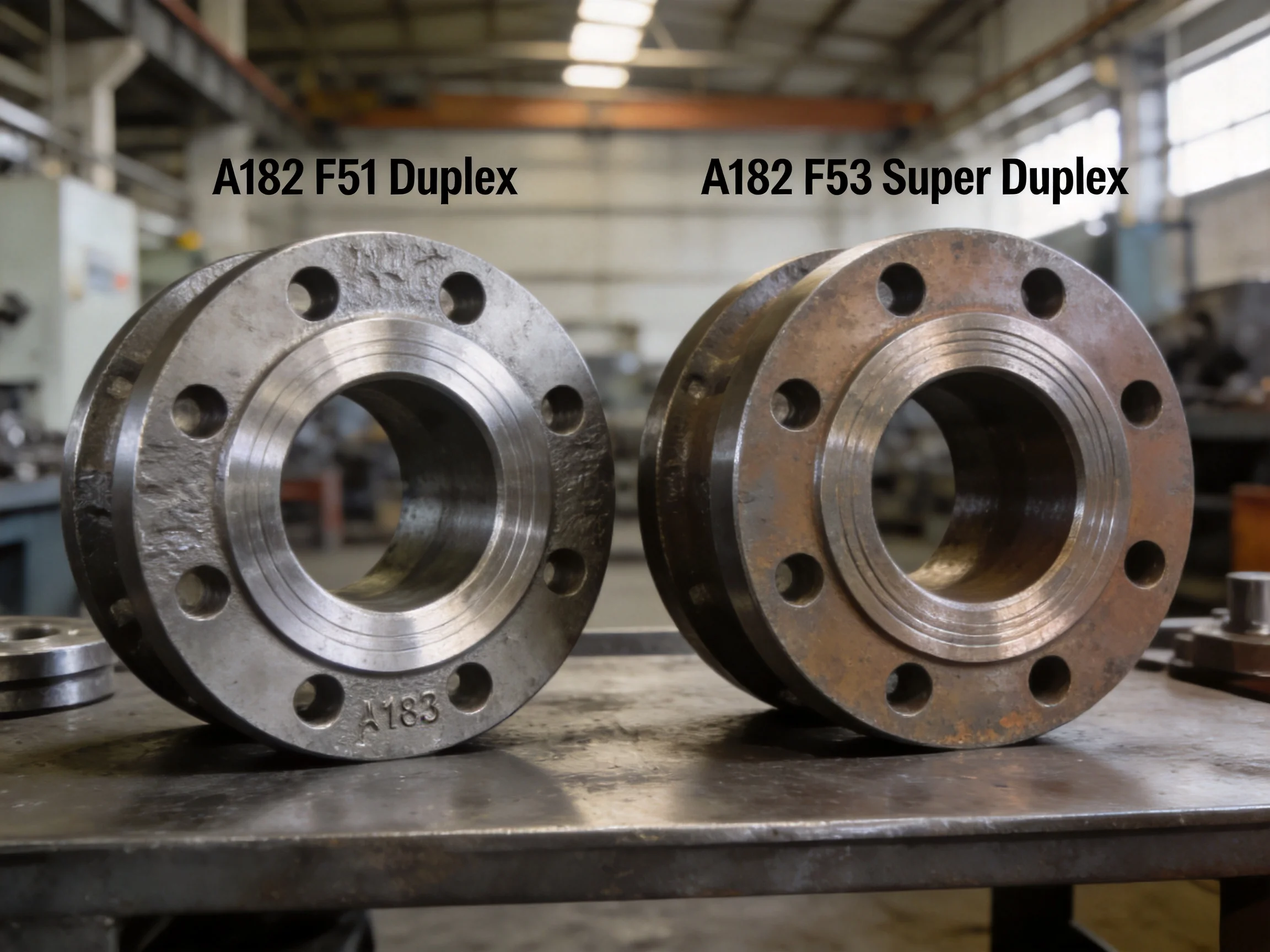
Chemical Composition: A182 F51 Duplex vs A182 F53 Super Duplex
For desalination plants, the chemical composition of A182 F53 Super Duplex offers superior chromium, molybdenum, and nitrogen content compared to A182 F51 Duplex, directly enhancing pitting and crevice corrosion resistance in high-chloride environments. A182 F51 (UNS S31803/S32205) is a standard duplex stainless steel with a balanced austenite-ferrite microstructure, while A182 F53 (UNS S32750) is a super duplex grade with higher alloying elements. The table below details the key compositional differences per ASTM A182 and NACE MR0175/ISO 15156 standards.
| Element (wt%) | A182 F51 (UNS S31803/S32205) | A182 F53 (UNS S32750) |
|---|---|---|
| Chromium (Cr) | 21.0–23.0 | 24.0–26.0 |
| Nickel (Ni) | 4.5–6.5 | 6.0–8.0 |
| Molybdenum (Mo) | 2.5–3.5 | 3.0–5.0 |
| Nitrogen (N) | 0.08–0.20 | 0.24–0.32 |
| Manganese (Mn) | ≤2.00 | ≤1.20 |
| Carbon (C) | ≤0.030 | ≤0.030 |
| PREN (Pitting Resistance Equivalent) | ≥34 (typical 35–38) | ≥40 (typical 41–45) |
The higher PREN of F53 (≥40 vs ≥34 for F51) indicates significantly better resistance to chloride-induced pitting, crucial for brine concentrations in desalination. For specific flange requirements, explore our duplex stainless steel flanges.
Mechanical Properties Comparison
A182 F53 Super Duplex flanges deliver approximately 25% higher yield strength and 15% higher tensile strength than A182 F51 Duplex, enabling thinner wall designs and higher pressure ratings in desalination systems. Both grades meet ASTM A182 requirements, but F53’s enhanced strength allows for reduced flange weight and cost savings in high-pressure applications. The table below compares key mechanical properties at room temperature per ASTM A182.
| Property | A182 F51 Duplex | A182 F53 Super Duplex |
|---|---|---|
| Yield Strength (MPa, min) | 450 | 550 |
| Tensile Strength (MPa, min) | 620 | 800 |
| Elongation (%, min) | 25 | 15 |
| Hardness (HRC, max) | 30 | 32 |
| Impact Toughness (J, -40°C) | ≥45 | ≥35 |
The higher strength of F53 comes with slightly reduced elongation and impact toughness, but it remains sufficient for desalination service. For high-pressure reverse osmosis (RO) vessels or thermal brine lines, our super duplex flanges are engineered to meet these demands.
Corrosion Resistance in High-Salinity Brine Environments
In desalination plants handling brine with salinity up to 70,000 ppm TDS and temperatures ranging from 25°C to 120°C, A182 F53 Super Duplex exhibits corrosion rates below 0.05 mm/year, while A182 F51 Duplex shows rates of 0.1–0.2 mm/year in similar conditions, making F53 the safer choice for critical brine lines. Testing per ASTM G48 (Method A) for pitting resistance shows that F53 withstands critical pitting temperatures (CPT) of 80–90°C in 6% FeCl3, compared to 50–60°C for F51. For crevice corrosion, F53 has a critical crevice temperature (CCT) of 70–80°C versus 40–50°C for F51. In high-chloride environments (e.g., 60,000 ppm Cl⁻ at 80°C), F51 may experience localized attack after 1,000 hours, while F53 remains passive. This is critical for thermal desalination (e.g., MSF, MED) where brine temperatures exceed 100°C. Per NACE MR0175/ISO 15156, F53 is recommended for sour service in oil & gas, but both grades are suitable for desalination with proper design.
Weldability and Fabrication Considerations
While both A182 F51 and F53 are weldable, F53 requires stricter heat input control (0.5–1.5 kJ/mm) and post-weld heat treatment (PWHT) at 1050–1120°C to avoid sigma phase precipitation, whereas F51 can be welded with a wider heat input range (0.5–2.5 kJ/mm) and often requires no PWHT for thinner sections. For desalination flange fabrication, F51 is easier to machine and weld, reducing fabrication costs by 15–20% compared to F53. However, F53’s higher hardness (up to 32 HRC vs 30 HRC for F51) accelerates tool wear, requiring carbide or ceramic tooling. Preheating is generally not needed for either grade, but interpass temperatures must be kept below 150°C for F53 and 200°C for F51 to prevent hot cracking. All welding should follow ASME Section IX and NACE MR0175 guidelines. For standard flanges, our forged flanges are available in both grades with certified weld procedures.
Cost Comparison: Material + Machining + Lifecycle
Despite a 30–50% higher material cost for A182 F53 Super Duplex compared to A182 F51 Duplex, the total lifecycle cost in aggressive desalination environments favors F53 due to reduced maintenance and longer service life (up to 25 years vs 15 years for F51). Material cost per kilogram: F51 ≈ $5–8/kg, F53 ≈ $8–12/kg (2024 market prices). Machining costs for F53 are 20–30% higher due to hardness and tool wear. For a typical 6-inch Class 150 flange, total fabricated cost: F51 ≈ $120–150, F53 ≈ $180–220. However, in brine recycle loops with temperatures above 80°C, F51 flanges may require replacement every 8–10 years, while F53 flanges last 15–20 years. Including labor and shutdown costs, F53 offers a 10–15% lower total cost of ownership over 20 years. For budget-sensitive projects with lower salinity (<30,000 ppm TDS), F51 remains cost-effective.
Case Study: A182 F51 Duplex in Middle East RO Plant
A major reverse osmosis (RO) desalination plant in Saudi Arabia (capacity 500,000 m³/day) selected A182 F51 Duplex flanges for seawater intake and product water lines, achieving a 12-year service life with minimal corrosion issues at temperatures below 40°C. The plant operates with seawater salinity of 42,000 ppm TDS and uses pre-treatment with chlorine. After 12 years, inspection revealed only minor pitting (depth <0.1 mm) on a few flanges in the brine discharge line, where localized temperatures reached 45°C. The plant saved 25% on initial flange costs compared to using F53. This case demonstrates that F51 is suitable for low-temperature RO applications, but careful monitoring is needed for brine lines. For similar projects, our duplex flanges are widely used.
Case Study: A182 F53 Super Duplex in Thermal Desalination
In a multi-stage flash (MSF) desalination plant in the UAE (capacity 300,000 m³/day), A182 F53 Super Duplex flanges were installed in the brine heater and reject brine lines operating at 112°C and 65,000 ppm Cl⁻, with zero corrosion failures reported after 8 years of continuous operation. The plant originally used 316L stainless steel flanges, which failed within 3 years due to chloride stress corrosion cracking (CSCC). After upgrading to F53, corrosion rates measured via ultrasonic testing were below 0.03 mm/year. The higher PREN of 43 (vs 35 for F51) ensured resistance to pitting and crevice corrosion. This case highlights F53’s necessity for high-temperature, high-salinity thermal desalination processes.
Our Recommendation: When to Choose Each
Based on technical and economic analysis, A182 F51 Duplex is recommended for low-temperature RO plants (<50°C seawater) and product water lines, while A182 F53 Super Duplex is essential for high-temperature thermal desalination (MSF, MED) and brine lines above 60°C. For intermediate conditions (50–80°C, 30,000–50,000 ppm Cl⁻), evaluate corrosion risk: if continuous operation exceeds 5 years, choose F53. For flange connections in high-pressure RO vessels (e.g., 70 bar), F53’s higher yield strength allows thinner flanges, reducing weight and cost. Always consult NACE MR0175 and ASTM A182 for material selection. For custom solutions, contact us at Jiaji Forging.
FAQs: 6 Questions About A182 F51 Duplex and A182 F53 Super Duplex Flanges
Q: What is the main difference between A182 F51 and A182 F53 in desalination?
A: The main difference is corrosion resistance: F53 has a higher PREN (≥40 vs ≥34), making it more resistant to pitting and crevice corrosion in high-salinity brine, especially at temperatures above 60°C. F53 also has higher strength (yield 550 MPa vs 450 MPa) but is more expensive.
Q: Can A182 F51 flanges be used in thermal desalination plants?
A: Generally no, because thermal desalination (MSF, MED) operates at brine temperatures of 90–120°C with high chloride levels (>50,000 ppm). F51’s CPT of 50–60°C is exceeded, leading to pitting and potential failure. F53 is recommended for these conditions.
Q: What standards apply to these flanges for desalination?
A: Key standards include ASTM A182 (for forged flanges), ASME B16.5 (dimensions and pressure ratings), NACE MR0175/ISO 15156 (for sour service, if applicable), and ASTM G48 (for pitting resistance testing). For desalination, also consider ISO 15510 for stainless steel compositions.
Q: Are A182 F53 flanges more difficult to weld than F51?
A: Yes, F53 requires tighter control of heat input (0.5–1.5 kJ/mm) and interpass temperature (<150°C) to avoid sigma phase formation, which reduces toughness. F51 is more forgiving with heat input up to 2.5 kJ/mm and interpass up to 200°C. Both require filler metals matching the parent metal (e.g., ER2594 for F53).
Q: How long do these flanges last in a typical RO plant?
A: In a well-designed RO plant with seawater at 25–40°C, A182 F51 flanges can last 15–20 years in product water lines and 10–15 years in brine lines. A182 F53 flanges can exceed 20 years even in brine lines, provided temperatures remain below 60°C. In thermal plants, F53 lasts 15–25 years.
Q: What is the cost difference for a standard 6-inch Class 150 flange?
A: For a 6-inch Class 150 RF flange, A182 F51 costs approximately $120–150 (material + machining), while A182 F53 costs $180–220, a 30–50% premium. However, considering lifecycle costs, F53 may be more economical in aggressive environments due to fewer replacements.
Related Products & Resources from JIAJI FORGING
- Duplex 2205 vs Super Duplex 2507 Flanges: Material Selection
- Top 7 GOST 33259 Flange Suppliers for Caspian & CIS Oil
- Industrial Forging: The Backbone of High-Performance Manufac
- Large Diameter Weld Neck Flange Guide: ASME B16.47 Series A
- Top 7 Forged Flange Manufacturers in India for Oil & Ga
For more information, visit jiajiforging.com or contact us.