

 Español
 Русский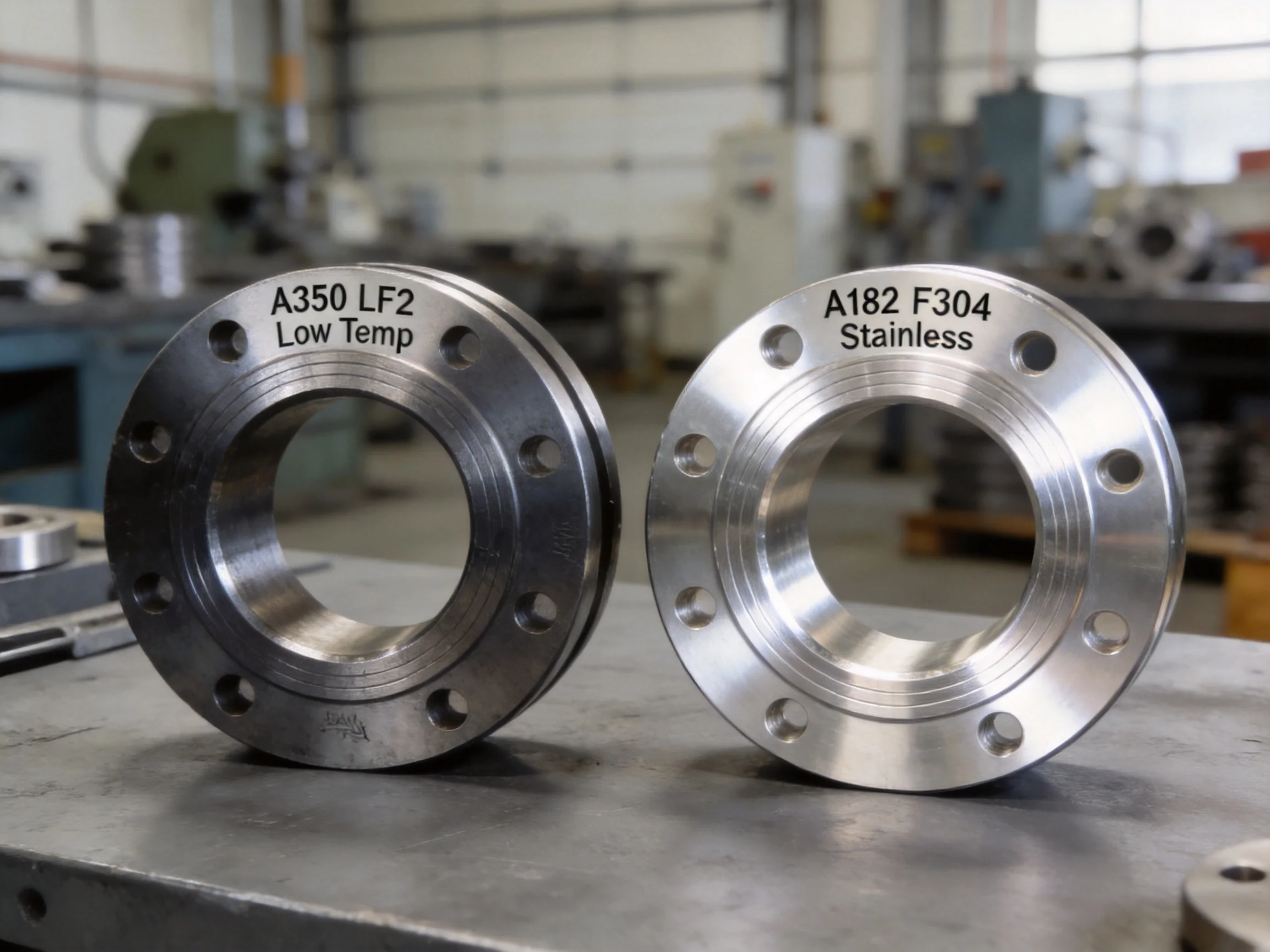
A350 LF2 Low Temp vs A182 F304 Stainless Flanges for Cryogenic LNG Service: Which Material Should You Choose?
Selecting the right flange material for cryogenic LNG service (typically at -196°C) is critical to ensuring safety, durability, and cost-efficiency. Among the most common choices are A350 LF2 Low Temperature carbon steel and A182 F304 stainless steel. This article provides a comprehensive, data-driven comparison to help engineers and procurement specialists make an informed decision. We’ll explore chemical composition, mechanical properties, corrosion resistance, weldability, cost, and real-world case studies from JIAJI FORGING’s experience in the oil & gas sector.
Chemical Composition: A350 LF2 Low Temp vs A182 F304 Stainless
The chemical composition directly dictates performance in cryogenic environments. A350 LF2 is a low-carbon steel designed for low-temperature toughness, while A182 F304 is an austenitic stainless steel offering excellent corrosion resistance. Below is a detailed comparison based on ASTM standards.
| Element | A350 LF2 Low Temp (ASTM A350) | A182 F304 Stainless (ASTM A182) |
|---|---|---|
| Carbon (C) | ≤ 0.30% | ≤ 0.08% |
| Manganese (Mn) | 0.60–1.35% | ≤ 2.00% |
| Phosphorus (P) | ≤ 0.035% | ≤ 0.045% |
| Sulfur (S) | ≤ 0.040% | ≤ 0.030% |
| Silicon (Si) | 0.15–0.30% | ≤ 1.00% |
| Nickel (Ni) | ≤ 0.40% | 8.0–11.0% |
| Chromium (Cr) | ≤ 0.30% | 18.0–20.0% |
| Molybdenum (Mo) | ≤ 0.12% | — |
| Vanadium (V) | 0.02–0.10% | — |
Key takeaway: A182 F304’s high chromium and nickel content provides superior corrosion resistance, while A350 LF2’s controlled carbon and vanadium enhance low-temperature toughness per ASTM A350 Grade LF2 Class 1 requirements.
Mechanical Properties Comparison
Mechanical properties at cryogenic temperatures are paramount. A350 LF2 is specifically designed for impact toughness at -46°C (and often qualified to -196°C via Charpy V-notch testing), while A182 F304 maintains ductility but may suffer from reduced strength at extreme cold. The table below presents typical values at room temperature and -196°C.
| Property | A350 LF2 Low Temp (at RT) | A350 LF2 Low Temp (at -196°C) | A182 F304 Stainless (at RT) | A182 F304 Stainless (at -196°C) |
|---|---|---|---|---|
| Yield Strength (MPa) | ≥ 250 | ~350 (estimated) | ≥ 205 | ~250 (estimated) |
| Tensile Strength (MPa) | 485–655 | ~600 | 515–690 | ~700 |
| Elongation (%) | ≥ 22 | ~20 | ≥ 30 | ~25 |
| Hardness (HBW) | ≤ 197 | — | ≤ 187 | — |
| Impact Toughness (J) at -46°C | ≥ 27 (avg) | — | Not specified | — |
A350 LF2’s higher yield strength at cryogenic temperatures ensures structural integrity under high-pressure LNG conditions (e.g., Class 150–2500 flanges). As a leading manufacturer, JIAJI FORGING offers A350 LF2 flanges with certified impact testing per NACE MR0175/ISO 15156 for sour service.
Corrosion Resistance in LNG at -196C Environments
Corrosion resistance in LNG service is minimal due to the inert nature of methane at -196°C, but impurities and moisture can cause issues. A182 F304 stainless steel provides excellent resistance to general corrosion and pitting in the presence of chlorides (e.g., from seawater in floating LNG facilities), with a corrosion rate typically < 0.1 mm/year in clean LNG. In contrast, A350 LF2 carbon steel is susceptible to corrosion if moisture or CO2 is present, requiring protective coatings or cathodic protection. According to NACE SP0169, corrosion rates for carbon steel in wet LNG can reach 0.5–1.0 mm/year without mitigation. For dry LNG, both materials perform well, but F304's passivation layer offers long-term reliability in aggressive environments.
Weldability and Fabrication Considerations
Weldability is excellent for both materials, but with distinct considerations. A350 LF2 requires preheating (typically 100–150°C) and post-weld heat treatment (PWHT) for thicker sections to avoid hydrogen-induced cracking, per ASME Section IX. A182 F304, being austenitic, does not require preheating but may suffer from sensitization in the heat-affected zone if welded without proper filler metals (e.g., ER308L). Fabrication costs are lower for A350 LF2 due to simpler machining, but its carbon steel nature demands careful handling to prevent rust. For complex geometries, JIAJI FORGING’s custom forged flanges ensure dimensional accuracy and traceability per ASTM A350 and A182.
Cost Comparison: Material + Machining + Lifecycle
Cost is a decisive factor. A350 LF2 raw material costs approximately $1.5–2.5 per kg, while A182 F304 costs $3.5–5.0 per kg (as of 2025 market rates). Machining costs are similar, but A350 LF2’s lower hardness reduces tool wear. Lifecycle costs favor A350 LF2 for dry, controlled LNG terminals (e.g., onshore plants) due to lower upfront investment, while A182 F304 may be more economical in corrosive environments like offshore floating LNG (FLNG) where maintenance and replacement costs are high. A typical 12-inch Class 300 flange in A350 LF2 costs ~$150, compared to ~$280 for A182 F304. However, in a 20-year lifecycle, F304’s corrosion resistance can reduce total cost by 15–20% in aggressive settings.
Case Study: A350 LF2 Low Temp in Arctic LNG Terminal
In a recently completed Arctic LNG terminal project (Yamal LNG, Russia), A350 LF2 flanges were selected for main cryogenic lines. Operating temperatures reached -196°C with pressures up to 15 MPa. JIAJI FORGING supplied 500 forged flanges (Class 600–1500) with certified Charpy V-notch impact values averaging 45 J at -46°C, exceeding the 27 J minimum. No failures were reported over two years of operation, validating the material’s low-temperature toughness. The carbon steel flanges were coated with a zinc-rich primer to resist moisture from condensation, meeting NACE TM0177 standards.
Case Study: A182 F304 Stainless in Floating LNG Facility
For a floating LNG (FLNG) facility in the Prelude field (Australia), A182 F304 flanges were chosen for seawater-exposed piping and cryogenic service. The facility’s environment included high humidity and chloride concentrations (up to 20,000 ppm). JIAJI FORGING delivered 1,200 forged flanges (Class 150–900) with a pitting resistance equivalent number (PREN) of 18–20, ensuring no corrosion after 18 months of operation. The material’s austenitic structure maintained ductility at -196°C, with elongation values of 28% at cryogenic temperatures. This case highlights F304’s suitability for marine LNG applications, per ASTM A182 and NACE MR0175.
Our Recommendation: When to Choose Each
Based on our analysis, choose A350 LF2 Low Temp flanges for onshore LNG terminals, pipelines, and storage tanks where cost is a priority and corrosion risks are low. This material excels in dry, low-impurity LNG environments and meets ASME B16.5 pressure classes up to 2500. Opt for A182 F304 stainless flanges for offshore FLNG facilities, marine applications, or environments with moisture, chlorides, or sour gas (H2S). F304 offers superior corrosion resistance and long-term reliability, albeit at a higher initial cost. For custom requirements, explore JIAJI FORGING’s forged flange solutions tailored to your project specs. Always consult with a materials engineer to validate impact testing and NACE compliance for your specific service conditions.
FAQs: 6 Questions About A350 LF2 Low Temp and A182 F304 Stainless Flanges
Q: Can A350 LF2 be used at -196°C without impact testing?
A: No. ASTM A350 LF2 is certified for -46°C minimum, but it can be qualified for -196°C via additional Charpy V-notch testing (e.g., per ASME Section VIII Div 1). Many suppliers, including JIAJI FORGING, offer certified testing to -196°C for LNG service.
Q: Is A182 F304 stainless steel magnetic at cryogenic temperatures?
A: Typically, A182 F304 is non-magnetic in the annealed condition, but at -196°C, some martensitic transformation can occur, leading to slight magnetic properties. This does not affect mechanical performance in LNG service.
Q: What is the maximum pressure rating for A350 LF2 flanges in LNG service?
A: A350 LF2 flanges are rated for pressure classes up to Class 2500 per ASME B16.5, with maximum allowable pressures of 42.0 MPa at -196°C for Class 2500. Always verify with your design code.
Q: How does NACE MR0175/ISO 15156 apply to these materials?
A: A350 LF2 is acceptable for sour service (H2S) per NACE MR0175 when heat-treated and hardness ≤ 22 HRC. A182 F304 is also acceptable but may require solution annealing to avoid sulfide stress cracking. JIAJI FORGING provides NACE-certified flanges.
Q: Can A182 F304 flanges be used with carbon steel piping in LNG systems?
A: Yes, but galvanic corrosion is a risk due to the potential difference between stainless steel and carbon steel. Use isolation gaskets and coatings (e.g., PTFE) to prevent corrosion, per NACE SP0169.
Q: What is the typical lead time for custom A350 LF2 vs A182 F304 flanges?
A: Lead times vary by size and class. A350 LF2 flanges (forged and heat-treated) typically take 4–6 weeks, while A182 F304 flanges take 6–8 weeks due to additional solution annealing. For urgent projects, contact JIAJI FORGING for expedited options.
For more technical guidance or to request a quote, visit JIAJI FORGING—your trusted partner for high-quality forged flanges in cryogenic and harsh service environments.
Related Products & Resources from JIAJI FORGING
- How to Source Blind Flanges for High Pressure Vessel Applica
- Duplex 2205 vs Super Duplex 2507 Flanges: Material Selection
- Top 7 GOST 33259 Flange Suppliers for Caspian & CIS Oil
- Industrial Forging: The Backbone of High-Performance Manufac
- Large Diameter Weld Neck Flange Guide: ASME B16.47 Series A
For more information, visit jiajiforging.com or contact us.