

 Español
 Русский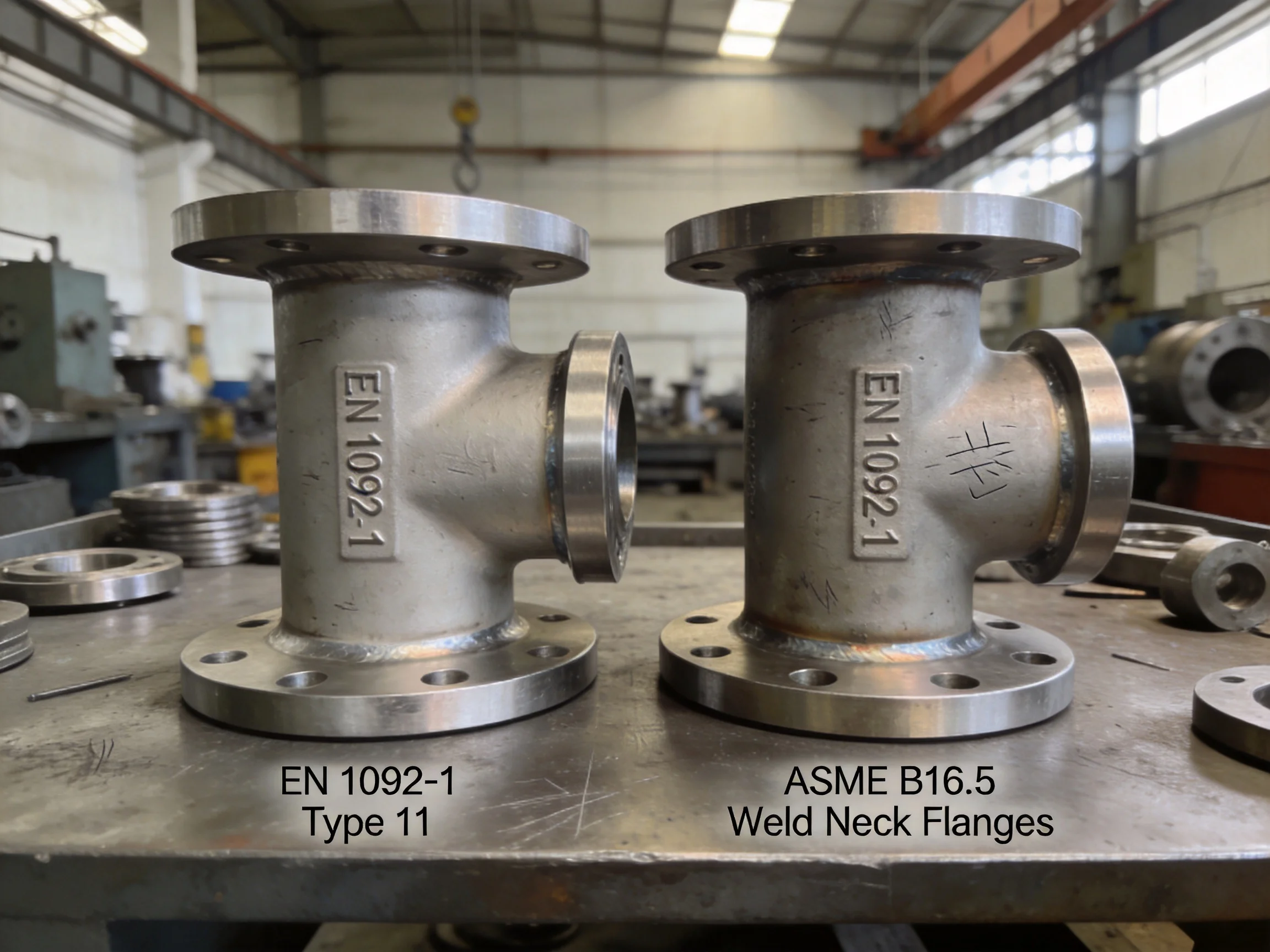
EN 1092-1 Type 11 vs ASME B16.5 Weld Neck Flanges: Complete Comparison for Kazakhstan Oil Projects (2026)
As a forging engineer with 15 years of experience at JIAJI FORGING, I have witnessed firsthand the critical importance of selecting the correct flange standard for oil and gas projects in the Caspian/CIS region. This article provides a technical, unbiased comparison between EN 1092-1 Type 11 and ASME B16.5 Weld Neck flanges, specifically tailored for procurement engineers working on Kazakhstan oil projects in 2026. We will cover pressure-temperature ratings, dimensions, material specifications, and practical selection criteria to help you make an informed decision.
What Is EN 1092-1 Type 11 and Where Is It Used?
EN 1092-1 Type 11 is a European standard flange designed for welding to pipe ends, commonly known as a weld neck flange. It is the direct European counterpart to the ASME B16.5 Weld Neck flange, featuring a long tapered hub that provides excellent stress distribution and fatigue resistance. This standard is mandated for pipelines and pressure vessels in European Union countries and is widely adopted in CIS regions, including Kazakhstan, due to historical ties and GOST harmonization.
EN 1092-1 Type 11 flanges are predominantly used in oil and gas, petrochemical, and power generation projects where EN or ISO standards are specified. In Kazakhstan, many upstream and midstream projects—such as those in the Tengiz, Kashagan, and Karachaganak fields—require EN 1092-1 Type 11 flanges for compliance with local regulations and GOST 33259 standards. JIAJI FORGING produces both EN 1092-1 Type 11 and ASME B16.5 Weld Neck flanges to meet these diverse requirements.
What Is ASME B16.5 Weld Neck and Where Is It Used?
ASME B16.5 Weld Neck is an American standard flange defined by the American Society of Mechanical Engineers, used globally for high-pressure and high-temperature applications. Its long tapered hub connects seamlessly to the pipe, reducing stress concentrations and making it ideal for critical services in oil and gas, chemical, and power industries. This standard is the default choice for projects following API, ANSI, or ASME codes.
In the Caspian/CIS region, ASME B16.5 Weld Neck flanges are commonly specified for international joint ventures, export pipelines, and refineries that adhere to Western engineering standards. For example, many multi-national operators in Kazakhstan prefer ASME B16.5 for its universal acceptance and interchangeability with global supply chains. Browse our complete catalog at jiajiforging.com for high-quality ASME B16.5 Weld Neck flanges in duplex, stainless, and nickel alloys.
EN 1092-1 Type 11 vs ASME B16.5 Weld Neck: Pressure-Temperature Ratings
The pressure-temperature rating is the most critical factor when comparing these two standards. EN 1092-1 Type 11 uses PN (Pressure Nominal) ratings (e.g., PN16, PN40, PN100), while ASME B16.5 Weld Neck uses Class ratings (e.g., Class 150, Class 300, Class 600). The key difference lies in the allowable working pressure at specific temperatures, with Class ratings generally offering higher pressure capabilities at elevated temperatures for equivalent nominal sizes.
Below is a comparison table for typical carbon steel flanges (material P265GH for EN, ASTM A105 for ASME) at 100°C. Note that exact values depend on material grade and temperature; always consult the respective standards for precise data.
| EN 1092-1 Type 11 Rating | Max Allowable Pressure (bar) | Max Allowable Pressure (psi) | Equivalent ASME Class | Max Allowable Pressure (bar) | Max Allowable Pressure (psi) |
|---|---|---|---|---|---|
| PN16 | 16 | 232 | Class 150 | 19.6 | 285 |
| PN40 | 40 | 580 | Class 300 | 51.1 | 740 |
| PN63 | 63 | 914 | Class 400 | 68.9 | 1000 |
| PN100 | 100 | 1450 | Class 600 | 102.1 | 1480 |
| PN160 | 160 | 2320 | Class 900 | 153.2 | 2220 |
Key insight: For typical oil and gas applications in Kazakhstan (e.g., pipelines at 50–100 bar), PN100 or Class 600 are often specified. ASME Class 300 is slightly higher rated than PN40, while PN100 is very close to Class 600. Always verify with your project’s design code, as some projects require exact equivalence per ISO 7005-1.
EN 1092-1 Type 11 vs ASME B16.5 Weld Neck: Dimension Comparison
Dimensional differences between EN 1092-1 Type 11 and ASME B16.5 Weld Neck flanges are significant, affecting bolt patterns, flange thickness, and overall size. EN flanges use metric dimensions (mm), while ASME flanges use imperial dimensions (inches), leading to non-interchangeability in most cases. The flange outside diameter (OD), bolt circle diameter (BCD), and number of bolt holes differ even for nominally equivalent pressure ratings.
Below is a comparison for a 6-inch (DN150) flange at PN40/Class 300, common in Kazakhstan oil projects. Note that EN Type 11 flanges for PN40 have a different OD and bolt pattern than ASME Class 300.
| Parameter | EN 1092-1 Type 11 (PN40) | Unit (mm) | ASME B16.5 Weld Neck (Class 300) | Unit (inch) | Unit (mm) |
|---|---|---|---|---|---|
| Flange Outside Diameter (OD) | 265 | mm | 11.0 | inch | 279.4 |
| Flange Thickness (t) | 24 | mm | 1.06 | inch | 26.9 |
| Bolt Circle Diameter (BCD) | 210 | mm | 8.75 | inch | 222.3 |
| Number of Bolt Holes | 8 | — | 8 | — | 8 |
| Bolt Hole Diameter | 22 | mm | 0.88 | inch | 22.2 |
| Hub Diameter at Base | 195 | mm | 7.68 | inch | 195.1 |
| Length Through Hub (L) | 64 | mm | 2.52 | inch | 64.0 |
Key insight: The ASME Class 300 flange has a larger OD and BCD than the EN PN40 flange, meaning they are not interchangeable without adapter rings or custom machining. For Kazakhstan projects, if the original design is EN-based (e.g., GOST 33259), you must use EN 1092-1 Type 11 flanges. Conversely, international projects often default to ASME B16.5. JIAJI FORGING provides detailed dimension charts for both standards to assist in procurement.
EN 1092-1 Type 11 vs ASME B16.5 Weld Neck: Material Specification Differences
The material specifications for EN 1092-1 Type 11 and ASME B16.5 Weld Neck flanges differ in naming conventions, chemical composition limits, and mechanical property requirements. EN standards use EN material designations (e.g., P265GH, 1.4401), while ASME standards use ASTM material designations (e.g., A105, A182 F316). Despite these differences, many materials are chemically and mechanically equivalent, allowing substitution with proper documentation.
Below is a comparison of common material specifications for carbon steel, stainless steel, and alloy steel flanges used in Kazakhstan oil projects.
| Material Type | EN 1092-1 Designation | ASME B16.5 Designation | Equivalent Grade (Common Name) | Typical Application |
|---|---|---|---|---|
| Carbon Steel | P265GH | ASTM A105 | 1.0425 | General service, oil & gas pipelines |
| Carbon Steel (Low Temp) | P355NH | ASTM A350 LF2 | 1.0566 | Low-temperature service (e.g., -20°C to -50°C) |
| Stainless Steel 304L | 1.4307 | ASTM A182 F304L | X2CrNi18-9 | Corrosive environments, food, chemical |
| Stainless Steel 316L | 1.4404 | ASTM A182 F316L | X2CrNiMo17-12-2 | Marine, chemical, sour service (H₂S) |
| Duplex Stainless Steel | 1.4462 | ASTM A182 F51 | X2CrNiMoN22-5-3 | Offshore, high chloride, sour gas |
| Nickel Alloy 625 | 2.4856 | ASTM B564 UNS N06625 | Inconel 625 | High temperature, severe corrosion |
Key insight: For Kazakhstan projects, carbon steel (P265GH or A105) is most common for general piping, while duplex stainless steel (1.4462 or F51) is increasingly specified for sour gas applications in the Caspian region. Always ensure that the EN material has a valid equivalent under ASME if dual certification is required. JIAJI FORGING supplies duplex and nickel alloy flanges for demanding oil and gas environments.
Which Standard Should You Choose for Caspian/CIS?
For Kazakhstan oil projects in 2026, the choice between EN 1092-1 Type 11 and ASME B16.5 Weld Neck flanges depends primarily on the project’s governing design code and client specifications. If the project follows GOST 33259, which is harmonized with EN 1092-1, or if the end user is a local Kazakh operator, EN 1092-1 Type 11 is the mandatory standard. Conversely, if the project is led by an international operator (e.g., Chevron, ExxonMobil, Shell) or requires API certification, ASME B16.5 is typically specified.
Here are three practical scenarios: (1) For new grassroots projects in the Tengiz or Kashagan fields, many international consortia default to ASME B16.5 due to global supply chain compatibility. (2) For pipeline expansions or revamps of Soviet-era infrastructure, EN 1092-1 Type 11 is often required to match existing flanges. (3) For critical sour gas or high-pressure services, both standards can be used, but ASME B16.5 Class 600 or higher is preferred for its wider acceptance in international design codes. JIAJI FORGING offers both standards with full material traceability to meet these diverse requirements.
Common Questions About EN 1092-1 Type 11 and ASME B16.5 Weld Neck (FAQ)
Q: Can EN 1092-1 Type 11 and ASME B16.5 Weld Neck flanges be bolted together?
A: No, they are generally not interchangeable due to different bolt circle diameters and flange OD dimensions. For example, a DN150 PN40 EN flange has a 210 mm BCD, while a 6-inch Class 300 ASME flange has a 222.3 mm BCD. Adapter flanges or custom machining may be required for direct connection.
Q: What is the equivalent PN rating for ASME Class 150?
A: ASME Class 150 has a maximum allowable pressure of approximately 19.6 bar at 100°C for carbon steel, which is slightly higher than PN16 (16 bar). The closest EN equivalent is PN16, but Class 150 has a higher rating. For exact equivalence, refer to ISO 7005-1 or consult your project’s design engineer.
Q: Are EN 1092-1 Type 11 flanges compatible with GOST 33259 flanges?
A: Yes, GOST 33259 (which is widely used in Kazakhstan and CIS) is harmonized with EN 1092-1 for Type 11 weld neck flanges. The dimensions, pressure ratings, and material specifications are essentially identical, making them fully interchangeable. Always verify the specific GOST edition (e.g., GOST 33259-2015) for exact details.
Q: Which material grade is best for sour gas service in the Caspian region?
A: For sour gas (H₂S) environments, duplex stainless steel (EN 1.4462 or ASTM A182 F51) or super duplex (EN 1.4410 or ASTM A182 F53) is recommended due to their high resistance to sulfide stress cracking. Carbon steel grades like A105 or P265GH must be heat-treated and hardness-limited per NACE MR0175/ISO 15156 for sour service.
Q: How can I ensure the flanges I purchase meet Kazakhstan’s regulatory requirements?
A: You should request a Certificate of Conformity (GOST-R or EAC) from the manufacturer, which certifies compliance with Eurasian Economic Union (EAEU) standards. Additionally, ensure that the flanges are supplied with material test reports (MTRs) and pressure test certificates. Contact JIAJI FORGING for certified EN and ASME flanges with full documentation for CIS projects.
Q: What is the typical lead time for custom EN 1092-1 Type 11 flanges in duplex steel?
A: For standard sizes (DN15 to DN600) in duplex stainless steel, JIAJI FORGING typically offers 4-6 weeks lead time for EN 1092-1 Type 11 flanges. For non-standard dimensions or nickel alloys, lead time may extend to 8-12 weeks. Always plan procurement early for Kazakhstan projects, especially during winter months when logistics can be delayed.
This technical comparison is provided by JIAJI FORGING, a leading Chinese manufacturer of forged flanges for oil and gas, petrochemical, and marine industries. For more information or to request a quote, visit jiajiforging.com.
Related Products & Resources from JIAJI FORGING
- How to Source Blind Flanges for High Pressure Vessel Applica
- Duplex 2205 vs Super Duplex 2507 Flanges: Material Selection
- Top 7 GOST 33259 Flange Suppliers for Caspian & CIS Oil
- Industrial Forging: The Backbone of High-Performance Manufac
- Large Diameter Weld Neck Flange Guide: ASME B16.47 Series A
For more information, visit jiajiforging.com or contact us.