

 Español
 Русский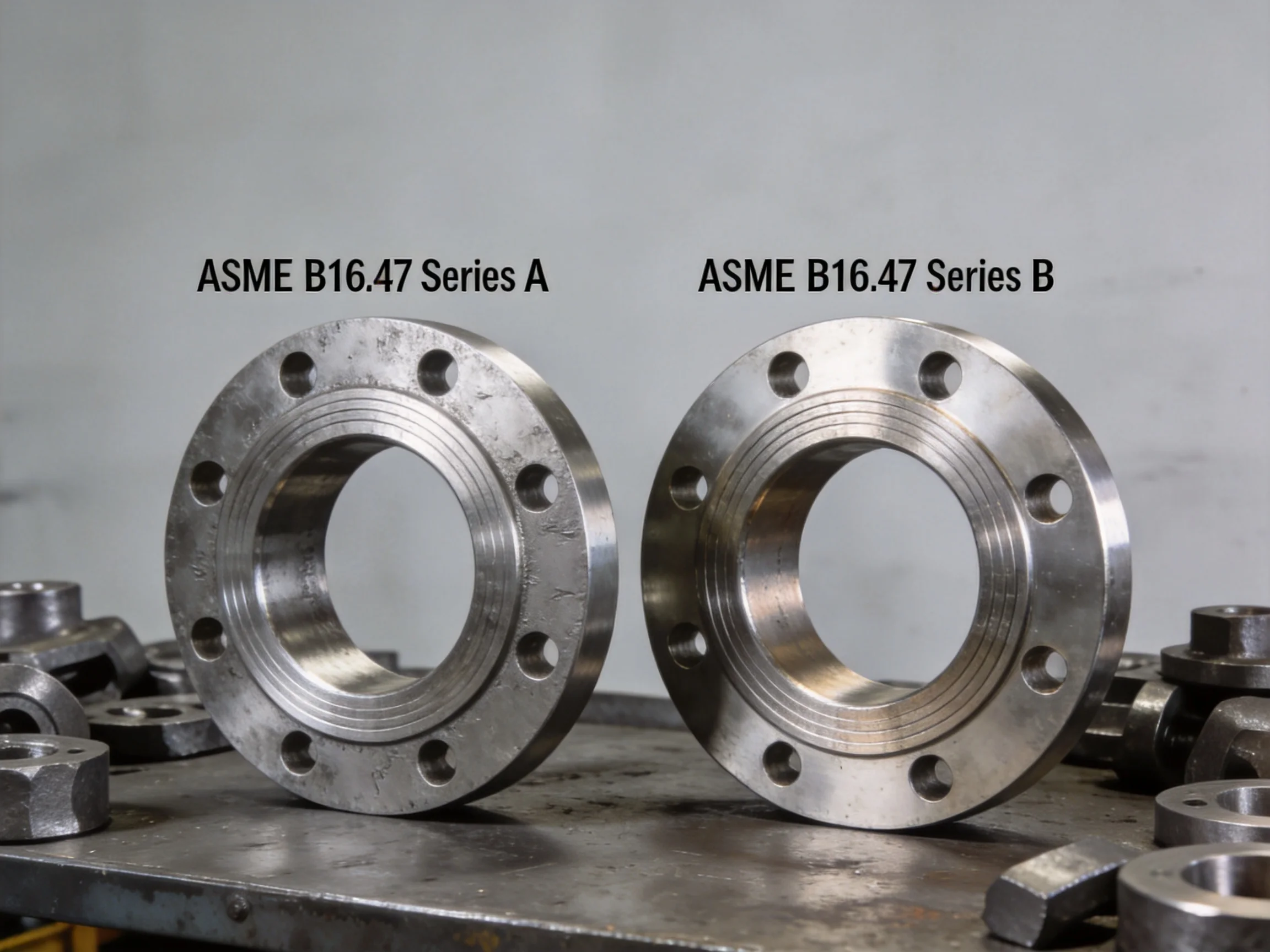
ASME B16.47 Series A vs ASME B16.47 Series B Flanges: Complete Comparison for Large Diameter Pipeline (2026)
In the global oil and gas industry, selecting the correct large-diameter flange standard is critical for pipeline integrity, cost control, and regulatory compliance. ASME B16.47 covers two distinct design series—Series A (MSS SP-44) and Series B (API 605)—for flanges from NPS 26 to NPS 60. This article provides a definitive, data-driven comparison of ASME B16.47 Series A vs Series B, focusing on pressure-temperature ratings, dimensions, materials, and application suitability for procurement engineers worldwide. JIAJI FORGING produces both ASME B16.47 Series A and ASME B16.47 Series B flanges in duplex, nickel alloy, and stainless steel, serving projects from the Caspian to the Middle East.
What Is ASME B16.47 Series A and Where Is It Used?
ASME B16.47 Series A flanges are heavy-duty, large-diameter flanges derived from the MSS SP-44 standard, designed for high-pressure and high-temperature applications. They feature a thicker hub, larger bolt circle, and heavier overall construction compared to Series B, making them suitable for critical oil and gas pipelines, refinery units, and offshore platforms. Typical uses include mainline transmission pipelines, subsea manifolds, and high-pressure separator connections where safety margins are paramount.
Key Characteristics of Series A
- Higher pressure ratings (Class 150 through Class 900) with thicker neck and flange face.
- Compatible with both raised face (RF) and ring-type joint (RTJ) sealing surfaces.
- Preferred in API 6A and ASME B31.3 process piping systems for sour service (NACE MR0175).
What Is ASME B16.47 Series B and Where Is It Used?
ASME B16.47 Series B flanges are lighter, more compact flanges based on the API 605 standard, originally developed for lower-pressure, large-diameter applications such as cooling water systems and general utility piping. They have a narrower face width, smaller bolt circle, and reduced hub thickness, which translates to lower material cost and weight. Series B is widely used in onshore pipeline terminals, tank farms, and low-pressure gas gathering systems where weight savings on supports and structures are beneficial.
Key Characteristics of Series B
- Typically limited to Class 150 and Class 300 ratings; higher classes are uncommon.
- Often supplied with a raised face only; RTJ is rare for Series B.
- Commonly specified in EN 1092-1 equivalent designs for European projects requiring lighter flanges.
ASME B16.47 Series A vs ASME B16.47 Series B: Pressure-Temperature Ratings
Series A flanges offer significantly higher pressure-temperature ratings than Series B across all nominal sizes, especially at elevated temperatures. For example, at 100°F (38°C), a Class 300 Series A flange can handle up to 740 psi (51 bar), while a Series B flange of the same class is limited to 640 psi (44 bar). The table below summarizes key ratings for common classes.
| Class | Temperature (°F/°C) | Series A (psi) | Series A (bar) | Series B (psi) | Series B (bar) |
|---|---|---|---|---|---|
| 150 | 100°F (38°C) | 285 | 19.7 | 195 | 13.4 |
| 150 | 500°F (260°C) | 230 | 15.9 | 160 | 11.0 |
| 300 | 100°F (38°C) | 740 | 51.0 | 640 | 44.1 |
| 300 | 500°F (260°C) | 660 | 45.5 | 560 | 38.6 |
| 600 | 100°F (38°C) | 1480 | 102.0 | N/A (max Class 300) | N/A |
| 900 | 100°F (38°C) | 2220 | 153.0 | N/A | N/A |
Note: Series B is not available above Class 300 per ASME B16.47. Ratings follow ASME B16.5 derating curves. Browse our complete catalog at jiajiforging.com for custom ratings.
ASME B16.47 Series A vs ASME B16.47 Series B: Dimension Comparison
Series A flanges are consistently larger and heavier than Series B flanges for the same nominal size and pressure class, impacting bolt pattern, face diameter, and hub dimensions. For example, a Class 300 NPS 26 Series A flange has an outside diameter of 34.00 inches (864 mm) and uses 24 bolts, while Series B measures 31.50 inches (800 mm) with 20 bolts. The table below provides a direct comparison for NPS 26 Class 150 and Class 300.
| Parameter | Class 150 Series A | Class 150 Series B | Class 300 Series A | Class 300 Series B |
|---|---|---|---|---|
| Outside Diameter (O.D.) | 31.50 in (800 mm) | 29.50 in (749 mm) | 34.00 in (864 mm) | 31.50 in (800 mm) |
| Bolt Circle Diameter | 29.00 in (737 mm) | 27.50 in (699 mm) | 31.50 in (800 mm) | 29.50 in (749 mm) |
| Number of Bolts | 20 | 16 | 24 | 20 |
| Hub Thickness at Neck | 1.75 in (44.5 mm) | 1.25 in (31.8 mm) | 2.25 in (57.2 mm) | 1.50 in (38.1 mm) |
| Flange Thickness (Min) | 1.88 in (47.8 mm) | 1.38 in (35.1 mm) | 2.25 in (57.2 mm) | 1.63 in (41.4 mm) |
| Approx. Weight (lbs) | 320 | 210 | 520 | 340 |
All dimensions per ASME B16.47-2020. For other sizes (NPS 28–60), the same trend applies: Series A is heavier by 30–50%. JIAJI FORGING provides detailed dimension charts for both series in our technical library.
ASME B16.47 Series A vs ASME B16.47 Series B: Material Specification Differences
Both series can be manufactured from the same material grades (e.g., ASTM A105, A182 F316, A694 F65), but Series A more commonly uses higher-strength alloys due to its higher pressure-temperature demands. Series B flanges are often specified in carbon steel (A105) or low-alloy steel for cost-sensitive applications, while Series A flanges in oil and gas frequently require duplex (UNS S31803), super duplex (UNS S32750), or nickel alloys (Inconel 625) for corrosion resistance in sour gas and subsea environments.
Common Material Choices
- Carbon Steel: ASTM A105 (forged) or A694 F52/F65 for both series; Series A often uses F65 for higher strength.
- Stainless Steel: ASTM A182 F316/316L for Series B; F304/304L or F316Ti for Series A in chloride environments.
- Duplex & Super Duplex: ASTM A182 F51 (UNS S31803) and F53 (UNS S32750) are common for Series A in offshore and sour service.
- Nickel Alloys: Inconel 625 (UNS N06625) and Hastelloy C276 (UNS N10276) are specified for Series A in extreme corrosive conditions.
JIAJI FORGING stocks both series in all these materials. Our duplex steel flanges meet NACE MR0175/ISO 15156 for H₂S service, a critical requirement for Middle East and Caspian projects.
Which Standard Should You Choose for Global?
For global oil and gas projects, the choice between Series A and Series B depends primarily on operating pressure, weight constraints, and regional code preferences. Series A is mandatory for high-pressure systems (Class 600 and above), sour service, and offshore applications where safety factors are highest. Series B is cost-effective for low-pressure utility lines, tank farm piping, and onshore gathering systems, especially in regions following European norms (EN 1092-1) where lighter flanges are accepted.
Decision Matrix
- Choose Series A if: Design pressure > 300 psi; temperature > 400°F; sour service (NACE); subsea or Arctic pipeline; Class 600 or higher required.
- Choose Series B if: Design pressure < 300 psi; weight savings critical (e.g., structural supports); Class 150 or 300 only; non-corrosive media; budget constraints dominate.
- Regional Note: In the Caspian region, GOST 33259 is also used, but ASME B16.47 Series A is often specified for Western-designed facilities. Consult JIAJI FORGING’s engineering team for cross-standard compatibility (e.g., PN to Class conversions).
Common Questions About ASME B16.47 Series A and ASME B16.47 Series B (FAQ)
Q: Can ASME B16.47 Series A and Series B flanges be bolted together?
A: No. Series A and Series B flanges have different bolt circle diameters, face dimensions, and hub geometries, making them mechanically incompatible. They cannot be directly bolted together unless an adapter is used, which is not recommended for pressure-retaining applications.
Q: Which series is more expensive, and why?
A: Series A flanges are typically 30–60% more expensive than Series B for the same size and class due to higher material weight, thicker hubs, and more rigorous manufacturing tolerances. For example, a NPS 26 Class 300 Series A flange weighs approximately 520 lbs, while Series B weighs 340 lbs, directly impacting raw material cost.
Q: Are there any pressure classes beyond Class 900 for Series A or Series B?
A: ASME B16.47 only covers up to Class 900 for Series A and Class 300 for Series B. For higher pressure ratings (Class 1500 or Class 2500), engineers should refer to ASME B16.5 (up to NPS 24) or custom designs per ASME B16.48 for larger diameters. Series A Class 900 is rarely used; most high-pressure large-diameter applications use API 6A flanges.
Q: Do ASME B16.47 flanges comply with EN 1092-1 or GOST 33259 standards?
A: No, ASME B16.47 is a distinct inch-based standard. However, PN-rated flanges (e.g., PN 40) can be approximated using dimension tables from EN 1092-1 Type 11 or 12 for Series B equivalents. JIAJI FORGING can manufacture flanges to multiple standards, including ASME, EN, and GOST, for global projects.
Q: What material certifications are required for Series A flanges in sour gas service?
A: For sour gas (NACE MR0175/ISO 15156), Series A flanges must be made from materials with controlled hardness (e.g., A105 with hardness ≤ 22 HRC) and undergo PMI testing, impact testing at -46°C, and hydrostatic testing. JIAJI FORGING provides full traceability and third-party certification (e.g., DNV, Lloyds) for all duplex and nickel alloy flanges.
Q: Can I use Series B flanges for subsea pipelines?
A: No. Subsea pipelines require high-strength, thick-hub flanges (typically Series A or API 6A) to withstand external hydrostatic pressure and dynamic loads. Series B lacks the necessary hub thickness and bolt strength for subsea applications.
This comparison is based on ASME B16.47-2020, API 605, and MSS SP-44 standards. For project-specific engineering support, contact JIAJI FORGING’s technical team. We supply high-quality forged flanges for global oil and gas, petrochemical, and marine industries.
Related Products & Resources from JIAJI FORGING
- How to Source Blind Flanges for High Pressure Vessel Applica
- Duplex 2205 vs Super Duplex 2507 Flanges: Material Selection
- Top 7 GOST 33259 Flange Suppliers for Caspian & CIS Oil
- Industrial Forging: The Backbone of High-Performance Manufac
- Large Diameter Weld Neck Flange Guide: ASME B16.47 Series A
For more information, visit jiajiforging.com or contact us.